
If your yard in Mobile, AL turns to standing water and stays that way for days — long after the last storm has blown through — a French drain is usually the fix. The reason it works here has less to do with how much it rains and more to do with what sits a few inches under your grass.
What a French Drain Actually Does
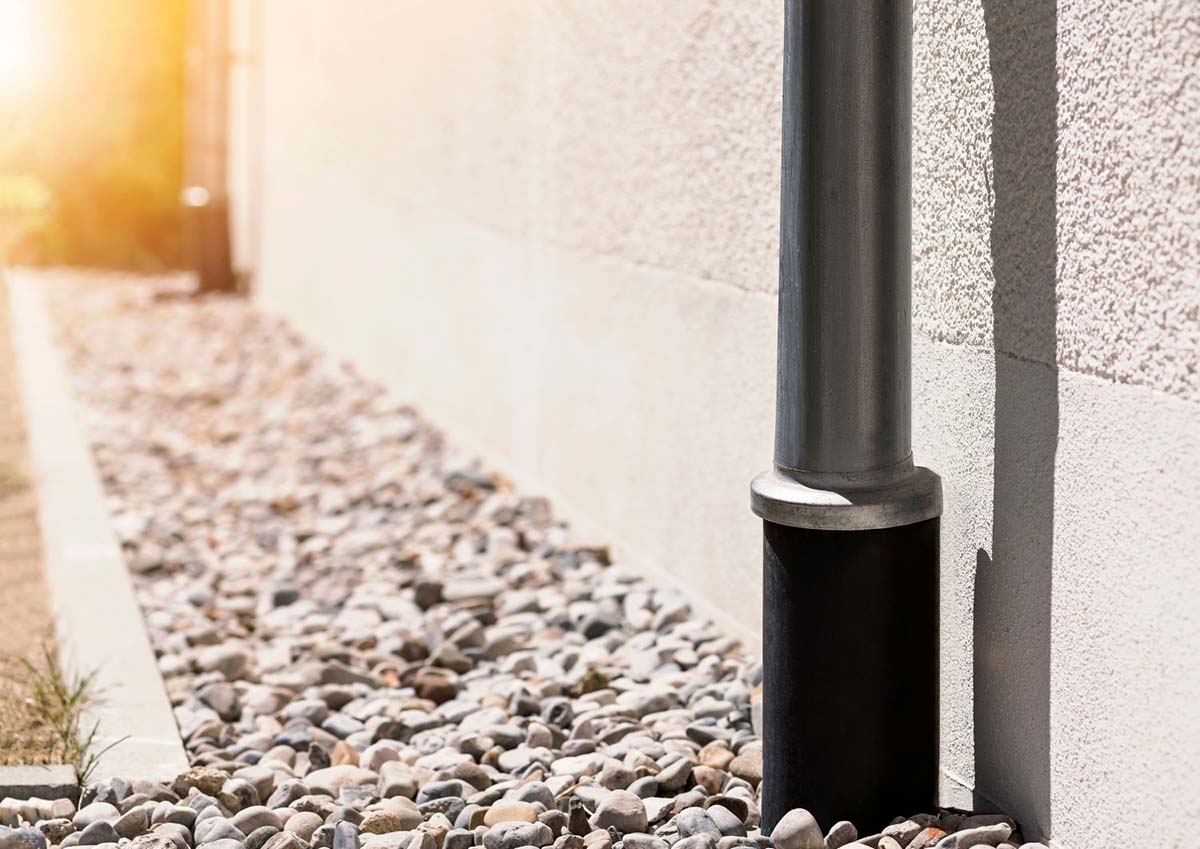
A French drain is a gravel-filled trench with a perforated pipe at the bottom, wrapped in filter fabric. Water in the surrounding soil follows the path of least resistance, seeps into the gravel, drops into the pipe, and is carried by gravity to a lower outfall — a ditch, a dry well, or a daylight point at the edge of your property. There is no pump and there are no moving parts; the drain simply gives trapped water somewhere lower to go.
That design is a good match for Mobile because the problem here is so often subsurface. The area gets about 67 inches of rain a year (NOAA/NCEI 1991–2020 normal), which is a lot — but a chronically wet yard is not only a rainfall story. It is a water-table story, and that changes what actually fixes it.
Why French Drains Work on Mobile’s Wet-Flat Yards
The low, flat parts of Mobile County — the old flatwoods around the city and out through Prichard, Saraland, and the Theodore bottoms — are deeply weathered ground where the soil is sandy loam over a clay-enriched subsoil that perches water: rain soaks through the loose top layer and then stalls on the tighter soil beneath it. (Not every Mobile lot is like this — the sandy uplands drain well — which is exactly why the diagnosis comes first.) On the poorly drained spots, the seasonal high water table can sit within 12 inches of the surface from December through April (USDA-NRCS). Your lawn spends the cool season resting on top of saturated ground, so any new rain has nowhere to soak away.
A French drain solves that by dropping below the saturated zone and handing the water a lower exit. This is a winter problem first. Summer brings the heaviest downpours and the tropical systems — the Mobile area has seen roughly 38 named storms since 1995 (NWS Mobile, counting the agency’s own list) — and those events absolutely make a wet yard worse. But the season-long sogginess that kills grass and keeps you off the lawn is a cool-season, high-water-table problem, and a well-placed French drain is built for exactly that.
One honest caveat: not every Mobile yard needs one. If your lot sits on the sandy uplands out toward West Mobile, Semmes, or Tillmans Corner, that ground drains well on its own, and standing water there is more likely a runoff or grading issue than a water-table one. We will tell you which you have before quoting a French drain you may not need.
How We Install a French Drain
Every yard is different, but the sequence is consistent:
- Locate the water and the outfall. We find where the water collects and, just as important, where it can legally and physically go — the low point that lets gravity do the work.
- Cut the trench to grade. The trench is dug to a steady downhill slope so water always moves toward the outfall, never sits in the pipe.
- Line it with filter fabric. Fabric keeps soil and silt out of the gravel so the drain does not clog and lose capacity over the years.
- Set washed gravel and perforated pipe. The pipe goes in low, holes down, bedded in clean stone that lets water in from every direction.
- Backfill, restore, and test. We close the trench, restore the surface, then run water through the system to confirm the yard actually drains before we call it done.
Because it is a gravity system, a French drain keeps working with no power and very little maintenance — the filter fabric is what protects that lifespan.
French Drains vs. Surface Drainage
The two solve different problems, and Mobile yards sometimes need both. Surface drainage — catch basins, channel drains, regrading — moves water that is sitting on top of the ground: a low spot in the lawn, runoff sheeting off a driveway, a downspout dumping at the foundation. A French drain handles water in the ground: the saturated, spongy soil of a high winter water table. If your problem squishes underfoot for weeks, it is subsurface, and surface fixes alone will not reach it. Matching the right tool to the right problem is the difference between a yard that finally dries out and one that stays wet after an expensive dig.
If you are watching water stand in your Mobile yard right now, the fastest way to know whether a French drain is the answer is an on-site look at your grade, your soil, and where the water can be sent.